Return Home
Definitions of Terms Related to Tea
The Mystery of Tea unveiled: Learn fast & easy about your favorite beverage by exploring the definitions of terms related to Tea that are listed below.  Click on the term to jump to the definition, or scroll through the entire list.  Please note that the Tea Fountain selection relating to the described terms are also listed in the definition, so if you want to try a wonderful selection like a Singbulli estate tea, you can make note of the item number and use the search engine on the tea ordering page to find the detailed product description
Accessories
Africa
Assam
Auctions
Autumnal
Bancha
Bitters
Blend
Boston Tea Party
Brewing
Broken
Broken leaf grades
Bulk
Caffeine
Camellia sinensis
Catechin
Ceremony
Ceylon
Cha No Yu
China
Chun Mee
Climate
Coarse cuts
CTC
Darjeeling
Decaffeinated tea
Dimbula
Dooars
Dragon Pearl
Drying
Dust
Earl Grey
East Friesian blend
English Breakfast
Essential oils
Fannings
Fermentation
Fine cuts
First Flush
Flavorings
Fluoride
Formosa
Fruit Tea
Genmaicha
Ging
Gold Medal tea
Grades
Green Monkey
Green Mu Dan
Green Pekoe
Green Rooibos
Green tea
Growth
Gu Zhang Mao Jian
Gunpowder
Gyokuro
Hazelbank
Herbs
Hibiscus
Highgrown
Hui Ming
Hybrid
Iced tea
In between
India
Indonesia
Ingredients
Japan
Jasmine tea
Java
Ju Hua Cha
Keemun
Kenilworth
Kenya
Kokicha
Koslanda
Kwai Flower
Lapacho
Lapsang Souchong
Leaf
Leaf grades
Longview
Lot
Lovers Leap
Lowgrown
LTP
Lung Ching
Lychee tea
Makaibari
Malawi
Maloom
Margaret's Hope
Matcha
Matcha bowl
Matcha whisk
Mate
Milima/Marinyn
Monsoon
Muscatel
Namring
Natural flavorings
Nature-identical flavorings
Nepal
Nilgiri
Nuwara Eliya
Oaks
Oolong
Orange Pekoe
Organic cultivation
Orthodox
Packaging
Pai Mu Tan
Papua New Guinea
Patina
Pekoe
Pesticides
Pettiagalla
Pi Lo Chun
Popoff
Preparation
Price
Production, orthodox
Production CTC
Production LTP
Pu Erh
Rock candy
Rolling
Rooibos
Rosehip
Russian blend
Second Flush
Semi Leaf
Sencha
Sikkim
Silver Sprout
Singbulli
Smoked tea
Snow Buds
Souchong
Source countries
Southern India
Spider Leaf
Sri Lanka
Stalks
Storage
Sugar
Sumatra
Taiwan
Taloon
Tannin
Tannins
Tasting
Tea bag
Tea bags
Tea brick
Tea ceremony
Tea cone
Tea growing regions
Tea plant
Tea pot
Tea roses
Tea tasters
Teine
Temi
Temple of Heaven
Thailand
Thea assamica
Thea sinensis
Theine
Tigerhill
Tips
TransFair
Travancore
Uva
Vintage Himalaya
Vitamins
Water
Water temperature
Wellness
White tea
Winter Flush
Young Hyson
Yunnan

Accessories The right choice of tea is as important as the choice of the very different teapots, cups, glasses, tea caddys, filters and the numerous other accessories that have developed throughout the course of history just like the culture of drinking tea.
TeaFountain provides a range of related articles and accessories, which you will find also here on our website!
Africa Africa is a major producer of CTC teas. Here, harvesting takes place all year round. The biggest tea growing regions are Kenya and Malawi.
See our Kenya "Marinyn Estate" GFOP Whole Leaf Selection # 1041
Assam The world's largest contiguous tea growing region, situated on either side of the Brahmaputra in Northern India.
Type "Assam" into the 'search field' to see all TeaFountain Assam Estate Teas and Blends.
 Auctions In the producer countries, tea is sold via large-scale auctions to the individual tea brokers, who are able to pass on the offered prices to the importers. The importing countries in turn offer the brokers their best prices for the individual lots. At busy times, up to 10,000 tons may change hands at the weekly auctions. The biggest auction sites are Calcutta in India, Colombo in Sri Lanka, Jacarta in Java, Mombasa in Kenya, etc. Up to 1998, London was also an auction site (the only one in Europe). Today, auctions are only held in the source countries.
Autumnal The Darjeeling Autumnal begins after the second flush period (October/November) and has a more full-bodied taste than the second flush. The yields are not as high as during the peak times, however.
TeaFountain Selection # 1023 "Autumn Leaf"
Bancha Bancha is the traditional tea of Japan. It is generated during the production of Sencha and is coarser, low in caffeine (theine) and rich in tannins.
See our # 1315 Bancha and # 1316 Bancha-based Genmaicha
Bitters See tannins
Blend Blends are mixtures of different teas to produce a distinctive new taste, as in the familiar English, Scottish, Irish, Russian or our famous "East Coast" blends, e.g. # 1036.
 Boston Tea Party Immigrants to North America brought the tea-drinking tradition with them and created a new trend:

In Boston and Philadelphia tea was served as an elegant ritual, until the tightening of the tax laws in 1767 as a step to support the army and colonial governments. The result was an American boycott of English imports. At that time, tea was imported exclusively by the British East India Company. In 1773, when seven sea ships from London reached the American coast line, a long war began with the Boston Tea Party: New York and Philadelphia forced the landing tea ships to turn back, civil servants from Charleston upturned the cargo and in Boston the "Dartmouth" was stormed by Americans dressed as native Red Indians. Vowing to turn the Boston harbor into a huge "Tea Pot", they threw all 340 tea chests overboard within three hours.  This provocative act ultimately led to the beginning of the American War of Independence.

Brewing The bigger the vessel the tea is brewed in, the more its aroma is able to unfold. The best method is to pour the water onto the loose tea in the tea pot. According to the Japanese saying, "tea must swim!" Tea can be re-brewed up to five times without loss of quality. Indeed, the Chinese re-use it up to 12 times, which also has advantages in terms of the price ratio.
Broken Broken is the term for small-leaved tea. It is smaller than leaf tea but larger than fannings.
A good example is our TeaFountain House Blend # 1063 Scottish Breakfast Tea FBOP.
Broken leaf grades Broken Leaf Grades:
  • P/FP (Pekoe/Flowery Pekoe) Mainly in Ceylon and Southern India, also produced in some parts of Kenya. Usually coarser, fleshier broken leaf.
  • BOP coarse (Broken Orange Pekoe)  Coarse, Indonesian name for Pekoe. BPS (Broken Pekoe Souchong)  Name for Pekoe in Assam and Darjeeling.
  • TGFBOP1 (Tippy Golden Flowery Broken Orange Pekoe 1) Finest broken First Grade Leaves in Darjeeling and some parts of Assam. High tip content, uniform leaf. 
  • GFBOP1 (Golden Flowery Broken Orange Pekoe 1) Mainly produced in Assam as the top broken grade; the only tippy broken from Kenya.
  • GBOP (Golden Broken Orange Pekoe) Next, second-grade tea. Inhomogeneous leaf, fewer tips.
  • FBOP (Flowery Broken Orange Pekoe) Coarser broken with some tips from Assam, Ceylon, Indonesia, China and Bangladesh. In South America coarser, black broken. In Southern India, Pekoe is often known as FBOP.
  • BOP (Broken Orange Pekoe) Main broken grade in Ceylon, Southern India, Java and China.
  • BP (Broken Pekoe) From Indonesia. Ceylon, Southern India.
  • FBOPF (Finest Broken Orange Pekoe Flowery) Mainly from Ceylon's "low districts". A leafy BOP1 with Tips. Specialty: so-called "Spider Leaf".
  • BT (Broken Tea)  From Sumatra, Ceylon, some parts of Southern India. Usually a black, open, fleshy leaf, very bulky.
Bulk Bulks are blends of individual crops from the same plantation. Bulks are used when there is a high demand for tea from a particular plantation.
See our #1033 Darjeeling TGFOP1 "Tigerhill Estate"
Caffeine Natural protective toxin of the tea plant. Tea contains 4-10 % caffeine (teine), which gives it its stimulating effect. A cup of tea contains 20-70 mg of caffeine (teine), a cup of coffee 80-120 mg caffeine.
Camellia sinensis The original tea plant (also known as Thea sinensis and Chinese tea). Grows in the form of a bush in moderate climate zones and is even capable of surviving frost.
Catechin Catechin is the main part of acidic acids in tea. They are giving the typical bitter taste to some teas. Catechin is said to have a prophylactic effect against arteriosclerosis, heart attack and caries. Clinical studies are currently running world-wide.
 Ceremony The Japanese have preserved this ritual since the development of this kind of ceremony by Japanese Buddhist monks centuries ago. A tea ceremony is held among invited guests in a Japanese tea house (chashitsu). Those who enter the house leave their daily routine behind them for a while and withdraw into themselves to give thanks for nature and existence. After a small welcoming meal (a type of cake), the Matcha is prepared, whereby the host places the powdered tea in the earthenware bowl (chawan) with a special spoon (cha no yu), adds hot water and stirs or beats it with the tea broom (chasen). The bowl is then handed round the circle of guests. The audible slurping of the tea is an expression of appreciation. The process may be repeated several times, and the ceremony can last up to several hours. This is only a short overview of the ceremony. In order to get to know the spiritual meaning and the whole course of the event, as well as the content, just try it out, tea ceremony seminars are offered for example in many museums.
Ceylon Sri Lanka (Ceylon till 1972) produces a fresh, tangy, aromatic tea in the three main growing regions of Dimbula, Nuwara Eliya and Uva. The main harvests are January to March in the West (Dimbula), top qualities from January to March in Nuwara Eliya and late summer in the East (Uva).
Good examples are our # 1011 Ceylon Pekoe 'Nuwara Eliya' and # 1010 Highlands 'UVA' BOP.
Cha No Yu See tea ceremony
 China China has been growing tea for over 5 millennia (History link). Today, the Chinese produce a mild, smoky-flavored tea which is grown in 16 provinces and accounts for approx. 25 % of world production. They also show a great deal of skill in the manufacture of specialities, e.g. tea roses and tea bricks. The main harvest is between May and August. The People's Republic of China owns the largest cultivation area in the world and is the world's second biggest producer after India.Only a third of the tea produced is exported, however.
Chun Mee Green tea from China with long, rolled leaf.
See our Organic variety # 2007
Climate See Tea plant
Coarse cuts Term used to refer to fruit and herb teas whose individual constituents measure 2-7 mm.
TeaFountain Selection # 1322 China Green Tea "Lung Ching" Dragon Well
CTC Crushing, Tearing, Curling (see Production CTC)
TeaFountain Selection # 1001
 Darjeeling In the early 19th century, English colonials systematically established large plantations on the slopes of the Himalayas. The strong mountain sun and low night-time temperatures caused the leaves of the tea bushes to grow particularly slowly, resulting in the distinctive, mild aroma of this tea. Darjeeling tea ranks among the finest and most expensive varieties in the world.
Good examples are our # 1021 First Flush FTGFOP1 "Longview Estate" and # 1031 Second Flush FTGFOP1 "Rare Selection".
 Decaffeinated tea The decaffeination of black tea can be performed in 3 different ways: with methylene chloride, ethyl acetate or carbon dioxide. These substances are used to extract the caffeine ( from the tea, and are in turn also extracted with the aid of steam to render the tea drinkable again. The carbon dioxide method is the natural way to "decaf" a tea.
See our Selections # 1061 Darjeeling SF FOP and # 1752 Black Tea "Ginger Root & Peach".
Dimbula Tea growing region in western Ceylon. Produces first-class highgrowns such as the Ceylon OP1 Kenilworth.
TeaFountain Selection # 1065
Dooars Tea growing region in Northern India, situated west of Assam, strong flavor reminiscent of Assam tea.
Dragon Pearl Very rare and special tea with a hand-rolled, green leaf and Silver Tips (known also as Silver Needles).
TeaFountain Selection # 1608 China White Tea "Tai Mu Long Zhu" Jasmine Dragon Pearl
Drying See Production, orthodox
Dust The smallest leaf grade consisting of fine particles, very economical, mainly used in tea bags. Usually high in tannin but low in character.
 Earl Grey Bergamot oil was used to flavor what was probably the first flavored tea in the world. The English Earl Charles Grey hit on an idea for making this tea more interesting. He got the recipe from China, with which he had diplomatic contacts. "Earl Grey" is still probably the best known variety of Flavored Black Tea.
See our "Earl Grey" Selections # 1718 / 1720 / 1765 / 2001 / 2018 / 2702.
East Friesian blend Assam forms the basis of this strong, malty blend, which is enjoyed particularly in East Friesia (Northern Germany) with rock candy crystals and cream.
For the US market we changed the name to create our "East Coast Selections", e.g. # 1035 "East Coast Sunday Tea". These teas stand up to "harder" water conditions without tasting too mineral-like.
English Breakfast A blend characterized by English tastes. Always based on Assam and Ceylon.
TeaFountain Selection # 2019 Organic Whole Leaf Black Tea FOP "English Breakfast" Premium Choice.
Essential oils These determine the flavor and aroma of the tea. Approx. 200 aromatic compounds are known to exist, 23 of which have been identified so far.
 

Return to Top

 Fannings Small leaf grade, granular consistency, very economical, mainly used in tea bags. High in tannin but lower in quality and character than larger grades.
  • BOPF (Broken Orange Pekoe Fannings) Main grade in Ceylon, Indonesia, Southern India, Kenya, Mozambique, Bangladesh and China. Black-leaf tea, few added ingredients, uniform particle size, no tips. In Indonesia BOP fine, small-leaf BOP.
  • TGFOF (Tippy Golden Flowery Orange Fannings)
  • GFOF (Golden Flowery Orange Fannings) Finest grade in Darjeeling for teabag production.
  • FOF (Flowery Orange Fannings) Common in Assam, Dooars and Bangladesh. Some leaf sizes come close to the smaller broken grades.
  • OF (Orange Fannings) From Northern India and some parts of Africa and South America.
  • PF (Pekoe Fannings).
Fermentation See Production, orthodox
Fine cuts Fine cuts is the equivalent term for fannings in the case of fruit and herb teas. The maximum particle size for fine cuts is approx. 2 mm. See also Fannings.
First Flush The first shoots of the year in Darjeeling tea plants, between March and April, the first time when the leaves are 'flushed' out on screens to be processed. Mild, fresh and flowery taste, pale liquor.
See our First Flush # 1071 FTGFOP1 "Margarete's Hope Estate" and compare with the 'darker' Second Flush (Second harvest period) # 1032 GFOP from the same Estate.
Flavorings Nature-identical flavorings are obtained by chemical processes and are identical in their chemical composition to a substance occurring naturally in a raw or processed foodstuff of vegetable or animal origin.
They are used to flavor foods in which stability of taste, heat and acid resistance, a long shelf life and consistent quality are essential criteria. See also Natural flavorings.
Fluoride The high fluoride content in green tea is said to have an effect which slows down the build up of caries and therefore protects the mouth.
Formosa The former name for Taiwan.
Fruit Tea The basic ingredients of fruit tea are apple, hibiscus and rose hip. This can be varied to obtain any flavor and appearance, however.
See our Tea Section "GOURMET FRUIT MELANGE".
Genmaicha Japanese Bancha with roasted brown rice and popcorn. Pale brown liquor with pleasant aroma: slightly salty, grainy taste with a hint of sweetness.
TeaFountain Selection # 1316 Genmaicha
Ging Plantation situated in Northern Darjeeling. A particularly aromatic tea from this region is the Darjeeling FTGFOP1 First Flush Ging. When available see our Selection # 1056 .
Gold Medal tea See "Hui Ming"
Grades See Leaf grades
Green Monkey The Tai-Mu mountains to the north of the Chinese province of Fujian are home to this unusual tea which is made carefully by hand to give it its distinctive fresh, smooth character and white tips.
TeaFountain Selection # 1306 and # 1328.
Green Mu Dan Green tea rose. 50 young shoots are tied together by hand into a tea rose. Develops its full form and a fine, pleasant aroma when hot water is poured on.
See our 'White Tea' Selection # 1605 "Ju Hua Cha" Silver Needle Special
Green Pekoe From the Chinese province of Fujian; thin, carefully rolled, tippy leaf. Fresh, pleasant taste and clear, pale-green liquor.
TeaFountain Selection # 1307
Green Rooibos Aspalathus linoaris. Same plant as the Red Rooibos but unfermented, with a light, delicately tangy and herb-flowery character.
TeaFountain Selection # 2801
 Green tea The health benefits of green tea have been known to the Japanese for centuries. The beverage is already recommended in ancient Japanese textbooks, e.g. to improve concentration. Today we not only know that green tea is good for you: its healing powers are also the subject of scientific research.
As good examples see our Selections # 1319 Taiwan Green Tea "Divine Pi Lo Chun" Jade-Green Spring Snail, and # 1305 China Tea "Green Yunnan". 
Growth Depending on region and temperature, tea may grow all year round or only at certain times.
Gu Zhang Mao Jian Chinese tea from the Wuyi mountains along the Quishui river. Slightly sweet, chestnutty character. Harvested for 10 days in spring and slightly fermented. Ideal for newcomers to green tea.
TeaFountain Selection # 1301
Gunpowder Green tea variety with a hard, tightly rolled leaf. The leaves are rolled into homogeneous balls between the palm of the hand and the inside of the boiler.
Organic TeaFountain Selection # 2006
Gyokuro Japanese speciality. An exclusive tea known as "fine dewdrop" which is shaded with rice matting or foil weeks before the harvest to reduce the tannin and increase the caffeine content.
TeaFountain Selection # 1317
Hazelbank This small, picturesque garden in the Indian region of Assam produces one of the best teas in the world. It is named after Hazel, daughter of the famous civil servant Dr. Mead. The fullness, size and color of Hazelbank makes it a favorite among tea merchants.
TeaFountain Selection # 1003
 Herbs Herb teas have been prized and recommended for their beneficial effects on the nerves and internal organs since the ancient civilizations.
However, these products straight from "God's apothecary" are often less than divine in terms of taste. Once again, it is a case of finding the right mix. The herbal composition must have a balancing effect in order to be safely drunk over long periods.
Good examples are our Selections # 2435 Herbal Infusion "Nighttime Blend # 1" Wellness Tea, and # 2418 Herbal Infusion "Lemon Grass Fancy".
Hibiscus This plant originates from Sudan. Its flower has a pleasantly acidic taste.
See our variety from Thailand Selection # 2424.
Highgrown Very pale teas with a delicate aroma grown in the mountain regions of Ceylon.
See our Selection # 1066
 Hui Ming Hui Ming tea takes its name from the Huiming temple of Jungning in the south of the Chinese province of Zhejiang. To coincide with the opening ceremony of the Panama canal in 1915, an international exhibition was held in San Francisco for which every country selected its finest products. The Chinese tea was voted best and received the gold medal. Since then it has been known widely as Gold Medal Hui Ming.
Hybrid A cross between two plants.
Iced tea Tea also makes a refreshing drink for the summer months. Cold: Make a pot of fruit tea (e.g. Caipirinha, Apple/Lemon, Sangria or Cranberry) with a higher strength than usual, leave it to stand then add ice cubes. After a short time, you will be able to enjoy a refreshing cup of ice-cold tea.
See our Selection # 2234 Gourmet Fruit Melange "Beach Time".
In between "In between" refers to interval between the first flush and second flush harvesting periods (approx. April to mid May).

Return to Top

India India has been among the world's leading tea producers ever since the English brought tea to the country. The tea growing regions are Darjeeling, Terai, Sikkim, Assam and Dooars in the north of the country and Nilgiri in the south. India is the world's biggest tea consumer today.
See our Selection # 1050 Second Flush Sikkim TGFOP "Temi Estate"
Indonesia Indonesia produces strong, dark, tasty teas all year round. Harvesting takes place on Sumatra throughout the year. These teas are highly popular as an addition to blended varieties. Java also produces strong, dark, tasty teas - mostly fannings - during the dry period. Premium qualities.
TeaFountain Selection # 1046 Black Java OP "Taloon Estate"
Ingredients Active ingredients in Tea: The cheapest drink worldwide after water is one of the most valuable in terms of its chemical composition: approx. 32 % of its ingredients pass into the infusion.
Tea contains: Caffeine (teine) / Tannins / Amino acids / Proteins
Trace elements and minerals: fluoride, potassium, calcium, manganese
Vitamins: niacin, vitamin B1 and B2
Japan Japan produces exclusively green tea (approx. 100,000 tones p.a.), which is generally harvested mechanically. Approx. 90 % is used for domestic consumption. Harvesting takes place all year round depending on the tea variety. The most popular tea among the Japanese Bancha, Genmaicha and Gyokuro.
See our Selections # 1315, # 1316 and # 1317
Jasmine tea Probably the best known flavored Chinese tea. Perfumed exclusively with tender white jasmine flowers. These lose their scent within 20 hours of picking, and therefore have to be added to the tea immediately to give it the desired aroma.
See our Selection # 1314 China Green Tea "Jasmine Chung Hao"
Java Java produces strong, dark, tasty teas - mostly fannings - during the dry period. Premium qualities.
TeaFountain Selection # 1046 Black Java OP "Taloon Estate"
Ju Hua Cha White tea rose. 50 young shoots are tied together by hand into a tea rose. Develops its full form and a fine, pleasant aroma when hot water is poured on.
See our 'White Tea' Selection # 1605 "Ju Hua Cha" Silver Needle Special
Keemun Classic Chinese black leaf tea with a small, delicate leaf and a sweet aroma. Lower in teine than most other black (considered red in China) teas. Used as component in various "Russian Teas" because of its low tannin level.
See our Selections # 1016 China Black Tea "Keemun Red Emperor" Superior Grade and # 1049 "Russian Caravan Tea" Traditional Recipe.
Kenilworth This plantation is situated in Lower Dimbula and produces a full-bodied tea with a coppery liquor.
TeaFountain Selection # 1065
Kenya Kenya mainly produces strong-tasting fannings according to the CTC method. The main harvest is from December to March. A major buyer of this tea is England. Kenya is also the only African country which produces high-quality leaf teas: these are grown on the Milima and Marinyn plantation.
TeaFountain Selection # 1041
Kokicha A Japanese specialty. The green tea is first pulverized before being recompressed by a special process and cut into small, longitudinal slices. Pleasantly fresh with a pale, mild liquor. Another version in this category is the "Small veins tea". Broken leaves are blend with fine-cut veins of the tea bush.
TeaFountain Selection # 1318
Koslanda Organic tea producing plantation in Ceylon.
TeaFountain Selection # 2003
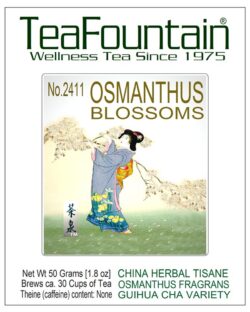
Kwai Flower This Chinese tea gets the name Kwai Flower from the osmanthus blossom. Also from China, this is a sweet-smelling plant with a strong, aromatic taste. In China it is also used in the manufacture of various foodstuffs such as sugar and wine.
TeaFountain Selection # 1302 and # 1502
Lapacho Lapacho is obtained from the bark of the rainforest tree Lapacho, whereby only the outer red bark is used in the production process. The bark contains numerous tannins, acids and vitamins. The tree does not have to be felled for this purpose, as the bark grows back again within a year.
TeaFountain Selection # 2504
Lapsang Souchong Classic Chinese black tea, flavored with the smoke from pine tree roots.
TeaFountain Selection # 1012
Leaf Leaf tea is the largest leaf grade. The virtually intact leaf is much prized for its fine aroma, particularly in the case of Darjeelings. Leaf teas currently account for approx. 2% of total tea production. See also leaf grades.
Leaf grades Whole Leaf Grades:  For more information, see our discussion on Tea Grades and Tea Production Techniques
  • FTGFOP1 (Finest Tippy Golden Flowery Orange Pekoe First Grade Leaves).
    Mainly from Darjeeling, also some parts of Assam. Finest top-grade production; made with special care; uniform leaf, tippy.
  • SFTGFOP1 (Special Finest Tippy Golden Flowery Orange Pekoe First Grade Leaves).
  • TGFOP1/TGFOP (Tippy Golden Flowery Orange Pekoe First Grade Leaves / Tippy Golden Flowery Orange Pekoe). Main grade in Darjeeling and Assam.
  • GFOP1 (Golden Flowery Orange Pekoe First Grade Leaves). Top grade in Milima and Marinyn - the only plantations in Kenya which produces leaf teas. Now less common in Assam and Darjeeling.
  • FOP/FOP1 (Flowery Orange Pekoe/Flowery Orange Pekoe First Grade Leaves). 2nd grade in Assam, Dooars and Bangladesh, top grade in China. Long leaf, few tips.
  • OP sup (Orange Pekoe Superior) Only from Indonesia.
  • OP (Orange Pekoe) Main grade in Ceylon and Java tea production. Can consist of long wiry leaf without tips.
  • BOP1 (Broken Orange Pekoe First Grade Leaves).
    Semi Leaf Tea. Specialty of "low districts" of Ceylon. Coarse, black-leaf tea, comprising roughly 40 % OP and 60 % Pekoe/BOP.
  • Off grades: Some OP2 (Orange Pekoe Second Grade Leaves). Leaf tea with added ingredients, but only in Ceylon and Southern India
Longview One of the first plantations to produce the first flush teas at the beginning of the year. Our vintage tea.
TeaFountain Selection # 1021
Lot The produce of the individual plantations is traded in lots. One lot consists of several crates, boxes or sacks.
Lovers Leap Dimbula plantation, light infusion, fresh taste, light citrus flavor.
TeaFountain Selection # 1052
Lowgrown Tea from the low-lying parts of Ceylon's tea growing regions. Lowgrowns generally have a stronger taste and a darker colored liquor.
TeaFountain Selection # 1065
LTP See Production LTP
Lung Ching Green tea from China with a flat, long leaf. The leaves are first stetched with the fingers and then pressed flat.
TeaFountain Selection #1322
 

Return to Top

Lychee tea Chinese tea flavored with the Chinese lychee fruit for a hint of exotic sweetness.
TeaFountain Selection # 1783
Makaibari Darjeeling plantation, organic cultivation.
TeaFountain Selection # 2004
Malawi Tea producing country in Africa. These tea growing regions produce better qualities than the rest of the continent. They specialize in strong-flavored fannings produced according to the LTP method.
Maloom Plantation in Nepal.
TeaFountain Selection # 1042
 Margaret's Hope Margaret´s Hope is situated approx. 10km south of the town of Darjeeling, north of Kurseong at a height of between 600 and 1500m above sea-level. The plantation acquired its current name at the beginning of the 20th Century in memory of the hopes of the daughter of the former plantation owner Mr. Crulkshank, who died from a serious tropical illness.
TeaFountain Selection # 1032 and # 1071
Matcha Japanese green powdered tea, mainly used for the Japanese tea ceremony.
Matcha bowl Handleless porcelain or ceramic bowl used in the Japanese tea ceremony. Plays an important spiritual role within the ritual.
Matcha whisk The Matcha whisk CHASEN is used in the Japanese tea ceremony to prepare the powdered tea in the bowl. One of the main elements of the ritual.
 Mate The Mate bush Ilex paraguariensis is indigenous to Brazil and Argentina and is botanically related to our holly plant. Mate is the only herb tea which, like green and black tea, contains the stimulants caffeine and theobromine. After harvesting and sorting, the Mate leaves and buds are quickly heated over fire to prevent them from turning black. This is followed by drying and crushing of the leaves. The end product is green Mate. Another milder version is also obtained by additional roasting, giving the consumer a choice between green Mate and roasted Mate.
TeaFountain Selections # 2602 and # 2603
Milima/Marinyn See Kenya and our Selection # 1041
 Monsoon The monsoon is a seasonal weather pattern typically associated with the Indian subcontinent. It is characterized by a seasonal reversal of the wind direction. This phenomenon is due to the distribution of land around the globe, whereby the continents are concentrated in the northern hemisphere. This situation is responsible for the anomaly of the summer ITCZ (Inner-Tropical Convergence Zone). The ITCZ describes the local pressure conditions, i.e. the amount of air flowing in the southerly and northerly direction. As with an offshore wind, a large part of this air flows back to the strongest point of irradiation, where it collides with the air from the other hemisphere. The ITCZ is the point of collision. The heating-up of the land mass and the resulting static thermal low in Tibet and parts of China causes this to shift a long way northwards, skipping the Himalayas. During the northern winter, the ITCZ is in its normal position slightly south of the equator.
Muscatel A tea from the Darjeeling region, picked during the late second flush period.
TeaFountain Selection # 1024
Namring Plantation in Darjeeling producing extremely fine, flowery teas; altitude 1,380 m, size: 475 hectares.
TeaFountain Selections # 1029 and # 1030
Natural flavorings Natural flavorings are obtained by physical, enzymatic or microbiological processes from raw materials of vegetable origin which are used as such or processed for human consumption using conventional foodstuff preparation techniques.
Nature-identical flavorings Nature-identical flavorings are obtained by chemical processes and are identical in their chemical composition to a substance occurring naturally in a raw or processed foodstuff of vegetable or animal origin. They are used to flavor foods in which stability of taste, heat and acid resistance, a long shelf life and consistent quality are essential criteria. See also Natural flavorings.
Nepal Tea growing region in north-east India. The teas are of medium strength with a flowery note comparable to a late harvest Darjeeling character.
Nilgiri Tea growing region in south-western India. Dark, wiry leaf similar to the plant products of Ceylon; tangy, golden liquor with a fruity flavor.
TeaFountain Selection # 1048
Nuwara Eliya Tea growing region in the uplands of Ceylon. Produces very pale tea varieties.
Oaks Plantation in Darjeeling.
TeaFountain Selection # 1020
Oolong Oolong production:
Oolong is a semi-fermented tea (18-30%). Its secret lies in the fermentation of the leaf's outer edges, while the heart of the leaf remains unfermented. It is mainly grown in Taiwan and China.
A superb example is our Selection # 1503 India Tea "Darjeeling Oolong" Okayti Estate.
Orange Pekoe See Leaf grades
Organic cultivation Various plantations and provinces have now switched to organic cultivation methods. These refrain from using any pesticides or plant protection agents, encouraging natural resistance instead by planting lemon trees between the tea plants.
Orthodox See Production, orthodox
Packaging Until a few years ago, tea was traditionally only shipped in wooden boxes. These gave the leaf suffcient protection, were easy to stack and preserved the aroma well thanks to their aluminium lining. Nowadays, cardboard boxes and sacks are often used for environmental reasons. Smaller leaf grades in particular (fannings, dust) are usually transported in sacks.
Pai Mu Tan Meaning "White Peony", this white tea has a delicate, flowery aroma. It is derived from the tip (Silver Needle) and the two most upper leaves of the plant, being jade green in color, and is slightly steamed . See also White tea.
TeaFountain Selection # 1601
Papua New Guinea Papua New Guinea produces a strong tea with a dark liquor all year round. Mainly fannings.
Patina Tannin residue deposited inside the tea pot.
Pekoe See leaf grades

Return to Top

Pesticides Pesticides (herbicides, insectides and fungicides) are used to ensure better plant protection and increase the productivity of the harvest. Pesticides are harmful to humans above a certain concentration. In the United States and Germany, the observance of the legal maximum values is therefore strictly monitored.
Pettiagalla Exquisite taste. Long. wiry leaf, highly aromatic. The plantation is located at an altitude of 1,000 m in the district of Balangoda
TeaFountain Selection # 1066
Pi Lo Chun "Green spring snail". Green tea with a wiry leaf which has a distinctive fresh scent and a fruity taste.
See our Selections # 1319 Taiwan "Divine Pi Lo Chun" and # 1329 China "Pi Lo Chun Supreme".
Popoff Popoff-Freres was supplier to the court of the Russian Czars as well as numerous European and Middle Eastern monarchs. These excellent, typically Russian blends were awarded the Grand Prix at the world exhibition in Paris in 1900. They were in vogue in both East and West, in court circles and in the elegant tea salons of the French bourgeousie.
 Preparation To obtain the stimulant effect of black tea, it should be brewed for 2-3 minutes. At this point, the tea develops its maximum caffeine (teine) content and improves concentration. If brewed for approx. 5 minutes, the tannins are released from the leaves and have a calming effect on the gastro-intestinal tract.
Since the brewing time varies according to variety, you should read the directions on the packet and rely on your own taste. Quantity and water quality are also important taste factors.
Price After water, tea is the cheapest drink there is. Even premium qualities only cost a few cents per cup.
TeaFountain Selection # 1024
 Production, orthodox

The orthodox production method:

This production method consists of five stages: withering, rolling, fermentation, drying, and sorting.

  1. The freshly picked green leaves are spread out to dry on ventilated trays. During this process, approx. 30% moisture is extracted from the leaves, making them soft and pliable for further processing.
  2. The leaves are then rolled by applying mechanical pressure to break up the cells and extract the cell sap. After 30 minutes, the leaves, still damp from the sap, are sieved to separate the finer leaves. These are spread out immediately for fermentation, while the remaining coarse leaves are rolled for a further 30 minutes under higher pressure. If necessary, this process is repeated several times. A short rolling time produces larger leaf grades, while longer rolling breaks the leaves up more resulting in smaller grades. During the rolling process, the cell sap runs out and reacts with oxygen, thus triggering the fermentation process. At the same time, the essential oils responsible for the aroma are released.
  3. After rolling, the tea is spread out in layers approx. 10 cm high for one to three hours in a cool, damp atmosphere to finish off the fermentation process. During this process, the substances contained in the cell sap oxidize. In this production phase, the green leaf gradually turns a copper color. The color and typical odor tell the person supervising the process how far the fermentation has progressed. Various chemical reactions cause the leaf to heat up during fermentation. It is critical for the quality of the tea that the fermentation process be interrupted at its peak, when the temperature is at its highest.
  4. Next, the tea is dried with hot air at a temperature of approx. 85º-88ºC in order to interrupt the oxidation process. The residual moisture is thereby extracted from the leaves, the extracted sap dries on the leaf and the copper-colored leaf turns dark brown to black.
  5. Finally, the dried tea is sieved to separate the different leaf grades. The orthodox production method provides teas of all leaf grades: leaf, broken, Fannings and Dust. Leaf grades only refer to the leaf size, however: they are not necessarily an indication of the quality of the tea.
 Production CTC The CTC production method: CTC stands for crushing, tearing and curling.
Both the CTC and LTP methods are mainly used for the finer end of the scale, i.e. fanning and dust grades.
These teas are usually destined for teabag production. The withered leaf is often cut to a uniform size by machine. Then the leaves are fed into the CTC machine where they are crushed, torn and curled in a single operation by metal rollers. The extracted cell sap is collected and added to the leaves again. The crushed leaves are then fermented, dried and sorted.
The CTC method is mainly used in Indian regions.
 Production LTP The LTP method:
The third method of producing black tea is the LTP method, named after the inventor of the relevant machine, the Lawrie Tea Processor. In this method, the withered leaves are often leveled before being processed in the LTP machine. Here they are virtually torn to pieces by blades rotating at high speed. This is followed by the usual fermentation, drying and sorting procedures.
The leaf grades result exclusively from the last stage of production, the sorting stage.
There are 4 basic groups in orthodox production:
Leaf, Broken, Fannings and Dust. These categories have nothing to do with quality, but only indicate the different leaf sizes and associated strengths.
Pu Erh Pu Erh (Pou Nei) is a strong-flavored tea with a fleshy leaf from the Chinese province of Yunnan. It gets its name from the town of Pu Erh, via which it is sold. It has a very earthy, pervasive aroma.
Pu Erh is produced according to highly traditional methods similar to those used approx. 2000 years ago in China.
TeaFountain Selection # 1017
Rock candy Rock candy crystals are often added to strong-tasting teas such as Assam, as well as English, Scottish and Ceylon blends. The addition of honey, milk or cream is also common.
Rolling See Production, orthodox
 Rooibos Rooibos is grown in the mild oceanic climate of the north-west coast of South Africa and harvested from January to March. Its needle-type leaves and yellow flowers are reminiscent of a gorse bush. For tea production, the young twigs are harvested, crushed and left to dry for several days in the sun. During this time, the natural fermentation process takes place, giving the tea its golden-red color and typical aroma. Rooibos has a full-bodied taste and a mild aroma.

The Red and Green Rooibos Bush Tea is the 'Soft Drink' from South Africa that is becoming increasingly popular with people who enjoy its mild, gentle fragrance and appreciate it as a healthy beverage because of its beneficial effects. This unfermented Green Rooibos is theine [caffeine]-free, low in tannin and carries a high content of antioxidants. Rooitea has a pleasant sweet taste and is delicious either hot or cold, can be enjoyed with Rock Candy Crystals or milk and may be mixed with fruit juice and ice cubes to prepare an exotic cocktail. To prepare: Use the same method as for Black Tea.
See our Selections # 2012 and # 2801

Rosehip The rosehip (Rosa canina) or dog rose is an important constituent of fruit teas due to the substances it contains (including a high vitamin C content).
TeaFountain Selection # 2421
Russian blend See Popoff
Second Flush The second main harvest period of the year, the time when the leaves are 'flushed' out on screens to be processed. The second flush is harvested between June and August, and has a fuller, nut/grape-like and stronger taste than the first flush, e.g.TeaFountain Selections # 1067 and # 1031.
Semi Leaf See leaf grade Ceylon BOP1
Sencha Sencha is probably the most poplar tea variety in Japan and has a long, flat leaf. Japanese Sencha has a fresh, slightly sweet taste, while Chinese Sencha is reminiscent of fresh hay and highly aromatic.
TeaFountain Selection # 1303
Sikkim Tea growing region to the north of Darjeeling, situtated between Nepal, Buthan and Tibet (China). An aromatic tea with a similarity to Darjeeling, grown in the unique Temi garden.
TeaFountain Selection # 1050
Silver Sprout Silver sprout is a crescent-leafed tea with a yellow-green liquor and an extremely fresh, mild aroma.
Compare with our Selection # 2007 Organic China Green Tea "Chun Mee" Precious eyebrow.
Singbulli Plantation/Estate in Darjeeling, situated at an altitude of 1,100 m, size: 750 hectares.
TeaFountain Selection # 1019
Smoked tea A Chinese tea smoked over pine needles. A familiar variety of smoked tea is Lapsang Souchong
TeaFountain Selection # 1012
Snow Buds Green tea with white tips and a pleasant 'White Tea character', honey-colored liquor. Mild, smooth taste. See also White Tea
Compare with our Selection # 1328 "Green Monkey # 2".
Souchong Chinese word for a large leaf.
Source countries See "Tea growing regions"
Southern India See Nilgiri

Return to Top

Spider Leaf A specialty from the highlands of the Ratnapura district. Characterized by a distinctively fine, needle-type leaf with tender, silver tips, the taste is spicy and has an unique/outstanding touch. It is produced in small quantities only.
Sri Lanka See Ceylon
Stalks This term refers to the small stalks and twigs which are picked with the tea and not sifted out during production. The Japanese Kukicha (Kokeicha) variety consists entirely of stalks which are roasted before use.
TeaFountain Selection # 1318
Storage As a highly sensitive natural product, tea must always be stored in dry conditions, as moisture is its worst enemy. It must be kept in sealed containers. Tea should be stored in a cool, dark place away from heat, light and the sun's rays. It is also advisable to store tea packaged in small units. It should not be kept in the fridge, the freezer or above your stove top area.
Sugar Sugar is an ingredient, which is often used, particularly in Europe. When carefully administered it will successfully round off the sense of taste. With most sensitive teas we recommend however to sweeten your hot beverages with Rock Candy Crystals.
Sumatra Harvesting takes place on Sumatra all year round. These teas are a popular addition to blends.
Taiwan Formerly known as Formosa.
Taloon Plantation/Estate in Java.
TeaFountain Selection # 1046
Tannin Tannin is one of the main constituents of tea, making up 8-20 % of its contents. They have a calming effect on the stomach and give the tea its typical strong, slightly bitter taste.
Tannins Tannic acids or tannins are bitter substances which act on the stomach and intestine. They also have an antibacterial effect which helps to restore a healthy bowel flora. A cancer-inhibiting effect described in scientific literature is attributed to individual tannin constituents along with a reduction in blood pressure.
Tasting See Tea tasters
Tea bag The tea bag was originally developed as a quick and easy way of supplying tea to soldiers in the war. Over time, the invention began to be used in other areas, and the double-chamber bag was introduced. This allows the water to surround the tea on all sides and bring out its full aroma. Normally only fannings or fine cuts are used in tea bags due to their higher concentration.
 Tea bags Tea bags have been increasing in popularity for some years, being handy and easy to proportion. Tea bags are made exclusively with leaf grades such as fannings and dust. It is not necessarily true that tea bags are of a lower quality than leaf teas. Fannings and dust are more economical than leaf teas due to their size and contain in general more tannin yet less character.

After a successful development period with our suppliers we are now introducing some of our High-Quality Teas & Blends in the innovative new 'Pyramid Bag'. The quality of the content exceeds by far the industry standard: Instead of filling Tea Bags with 1.5 Grams of economical low-grade teas we have 3 Grams of High-Quality teas, herbs & fruits filled into the larger NEW TEA BAG. Enjoy the exquisite taste and full flavor of the precious leaf teas and infusions.
These new Tea bags will soon be offered on our site. Call us at 415 507 0577 for more Info.

 Tea brick (Zhuan Cha/Dschuan-Tscha) In order to facilitate transportation of the tea and preserve its aroma for longer, the Chinese under the Tang dynasty (618-906 AD) developed the tea brick. After picking, the young leaves were steamed, crushed and mixed to a paste using plum juice as a binding agent. This paste was poured into a crucible and heated until dry. During this period, the tea brick was even used as a unit of currency. Modern tea bricks consist of tea dust compressed hydraulically into units weighing 1 and 2 pounds. They're intended for decoration rather than drinking.
TeaFountain Selections # 1326 Dschuan-Tscha, Green Brick Tea and # 1068 Dschuan-Tscha, Black Brick Tea.
 Tea ceremony The Japanese have perserved this ritual since its the development of this kind of ceremony by Japanese Buddhist monks centuries ago. A tea ceremony is held among invited guests in a Japanese tea house (chashitsu). Those who enter the house leave their daily routine behind them for a while and withdraw into themselves to give thanks for nature and existence. After a small welcoming meal (a type of cake), the Matcha is prepared, whereby the host places the powdered tea in the earthenware bowl (chawan) with a special spoon, adds hot water and stirs or beats it with the tea whisk (chasen). The bowl is then handed round the circle of guests. The audible slurping of the tea is an expression of appreciation. The process may be repeated several times, and the ceremony can last up to several hours. This is only a brief outline of the ceremony. To find out more about the spiritual side and the whole procedure and content, why not try it yourself: tea ceremony seminars are offered in many museums, for example.
Tea cone Chinese specialty tea. The young tea leaves are bundled together in small "balls" and tied with string. Then they are skillfully twisted by hand into a cone shape.
 

Return to Top

Tea growing regions Main tea growing regions of the world: India, Ceylon, China, Japan, Taiwan, Vietnam, Indonesia (Java, Sumatra) Kenya, Malawi, Bangladesh, Russia, Iran, Turkey, Uganda, Tanzania, Argentina
 Tea plant The tea plant (camellia sinensis) is a species of tree related to the camellia. Its flowers are yellowy-white and its fruits small and hard-shelled, similar to a hazelnut. The evergreen leaves are leathery, dark and slightly serrated. Given minimum annual temperatures of 18° C, moderate and infrequent frosts, a uniform annual precipitation of 1600 l and a good balance of sunshine, a tea plant can easily grow to become 100 years old. Wild tea plants are indeed reputed to reach an age of up to 1,700 years.
Two original tea plants are known today:
Thea sinensis (or Chinese tea): A shrub-like plant which reaches a maximum height of 3-4 m and can even survive frosts.
Thea assamica (or Assam tea): A substantial tree reaching a height of 15-20 m which grows exclusively in the tropics.
The constant crossing of these two original plants forms the basis of all the tea cultures in the world today.
Tea pot The tea pot should only be used for tea, never for coffee. Similarly, it should never be cleaned inside with washing-up liquid, as the soap affects the taste. In fact, the typical patina inside the pot actually improves the aroma of the tea.
Tea roses White tea-rose, about 50 young shoots are tied together carefully by hand into a tea-rose. When hot water is poured over, it takes on its outward appearance and its fine and pleasant aroma.
See our 'White Tea' Selection # 1605 "Ju Hua Cha" Silver Needle Special.
Tea tasters The tea taster tests teas for their appearance, aroma and taste in both the source and importing countries. A tea taster may sample up to 500 teas per day at peak times.
Teine See Caffeine
Temi Plantation/Estate in Sikkim.
TeaFountain Selection # 1050
Temple of Heaven Standard form of a Chinese Gunpowder variety. Tightly rolled, dark leaf.
Compare with our Certified Organic Selection # 2006.
Thailand Towards the Sudan, the most important growing area for hibiscus as main constituent of fruit tea mixtures.
TeaFountain Selection # 2424
Thea assamica Thea assamica (or Assam tea) is one of two original tea plants. Unless cut back, it grows into a substantial tree 15 to 20 m high. It needs a warm climate and is an exclusively tropical plant. It was first discovered in 1823 in what is now the Assam region.
Thea sinensis Thea sinensis (or Chinese tea) is one of two original tea plants. It retains a shrub-like stature even without pruning, reaching a maximum height of 10 to 15 feet. It is most suited to moderate climates and can even survive frosts. Source: "Thirsty for knowledge - a guide to tea" by the German tea marketing board.
Theine See Caffeine
Tigerhill Mountain in the Darjeeling region.
TeaFountain Selection # 10033
 Tips This refers to the light brown tips of the tea. Picked while young and tender, these tips do not have such a high tannin content as the older ones and do not turn the same copper color during fermentation. They are not specially indicative of quality except in the case of Assam teas.
 TransFair The tea we sell has been awarded the TransFAir fair trade seal by TransFair e.V.. Fair trade encourages self-sufficiency and equality on the part of disadvantaged trading partners in the third world. The higher price paid for the tea is used directly to improve the living conditions of the tea pickers and processors. The Organic MAKAIBARI variety is sold exclusively via specialty tea merchants.
TeaFountain Selection # 2004
 Travancore Southern Indian tea growing region.
 Uva The tea growing region Uva is located in the eastern part of Sri Lanka in the environs of the district capital Badulla. Lots of tea bushes grow here in the shade of the trees, resulting in a lush, full-bodied tea with a sweetish, tangy taste.
TeaFountain Selection # 1010
 Vintage Himalaya Vintage, like Autumnal, is a particular variety of the second flush Darjeeling.
TeaFountain Selection # 1034
 Vitamins Just like other green plants the tea leaf contains vitamins and provitamins. As well as fat-soluble vitamins there is also a wide range of water soluble vitamins.
However oxidation sensitive links are extensively disturbed by the fermentation process. So, for example, the ascorbic acid contained in the tea leaf is completely broken down in the manufacture of black tea. Oxidation sensitive vitamins are to be found in greater amounts in green tea than in black tea.
Water The choice of the right water is as important for a good cup of tea as the proportions and brewing time. The water should not have too much taste of its own, and should not be hard or high in limestone, chlorine or iron. Water with an excessively high salt content or oxidized magnesium is also unsuitable. A fine Darjeeling will never taste as good in a region with limy water as in one with a mild, soft water which allows its delicate aroma to fully unfold. The best water comes from springs in high mountain valleys. If you don't happen to have this to hand, you can resort to a lime filter or boil the water 2-3 times. Never use distilled water and let boiling water at 212 degrees F cool to 180 degrees F, particularly in the case of green tea, otherwise heat-sensitive enzymes may be destroyed. It is essential to boil the water first however, in order to incorporate the necessary oxygen into the water. Black tea should be made with boiling water, as the heat-sensitive enzymes have already been destroyed in this case by fermentation.
Water temperature The degree of hotness or coldness of the water (corresponding to its molecular activity).

Recommended temperatures to brew various categories of tea:
Prepare Black Tea, Herbal Infusions, Fruit Teas with boiling water at 212 degree F
Prepare Oolong Teas at 190 degree F
Prepare Green and White Tea, some First Flush Darjeelings at Teas 180 degree F

Wellness Tea not only quenches thirst, but also acts as a tonic. It stimulates the mind and creates a feeling of wellbeing.
Two ingredients of tea are responsible for its unmistakable yet diverse effect: the stimulant caffeine (teine) and the calm-inducing tannins.
 White tea White tea:
White teas originate mainly from the mountainous regions of Fujian in Southern China. The leaves are slow and gentle steamed in the open air and very carefully handled.
This tea is gaining more and more converts. Only the bud (Silver Needle) and two most upper leaves are plucked. Very low in tannin and teine. See also Pai Mu Tan.
A good example is our Selection # 1603 China White Tea "Mao Feng" Special Grade.
Winter Flush The so-called winter flush is harvested on rare occasions in the Indian Darjeeling region. When the first weak rays of the sun reach the delicate buds on the highest mountain slopes, an early harvest is sometimes possible. Winter flushes have a highly aromatic taste similar to the first flush.
Young Hyson Chinese tea from the province of Zhejiang. The thick, yellowy-green leaves are rolled into a long, thin shape during processing. Produces an intense green liquor.
TeaFountain Selection # 1304
Yunnan Yunnan is said to be the birthplace of tea. This province in south-eastern China still grows a strong-flavored tea with a fleshy leaf and golden tips. Can have a slight similarity with Assam.
See our Selections # 1013 Golden Yunnan and # 1059 Golden Needle Yunnan and # 1305 Green Yunnan.

Return to Top       


' . tep_image_button('button_continue_shopping.gif', IMAGE_BUTTON_CONTINUE) . ''; ?>